

How Pro SEO Packages Improve Search Visibility
Sep 1, 2026
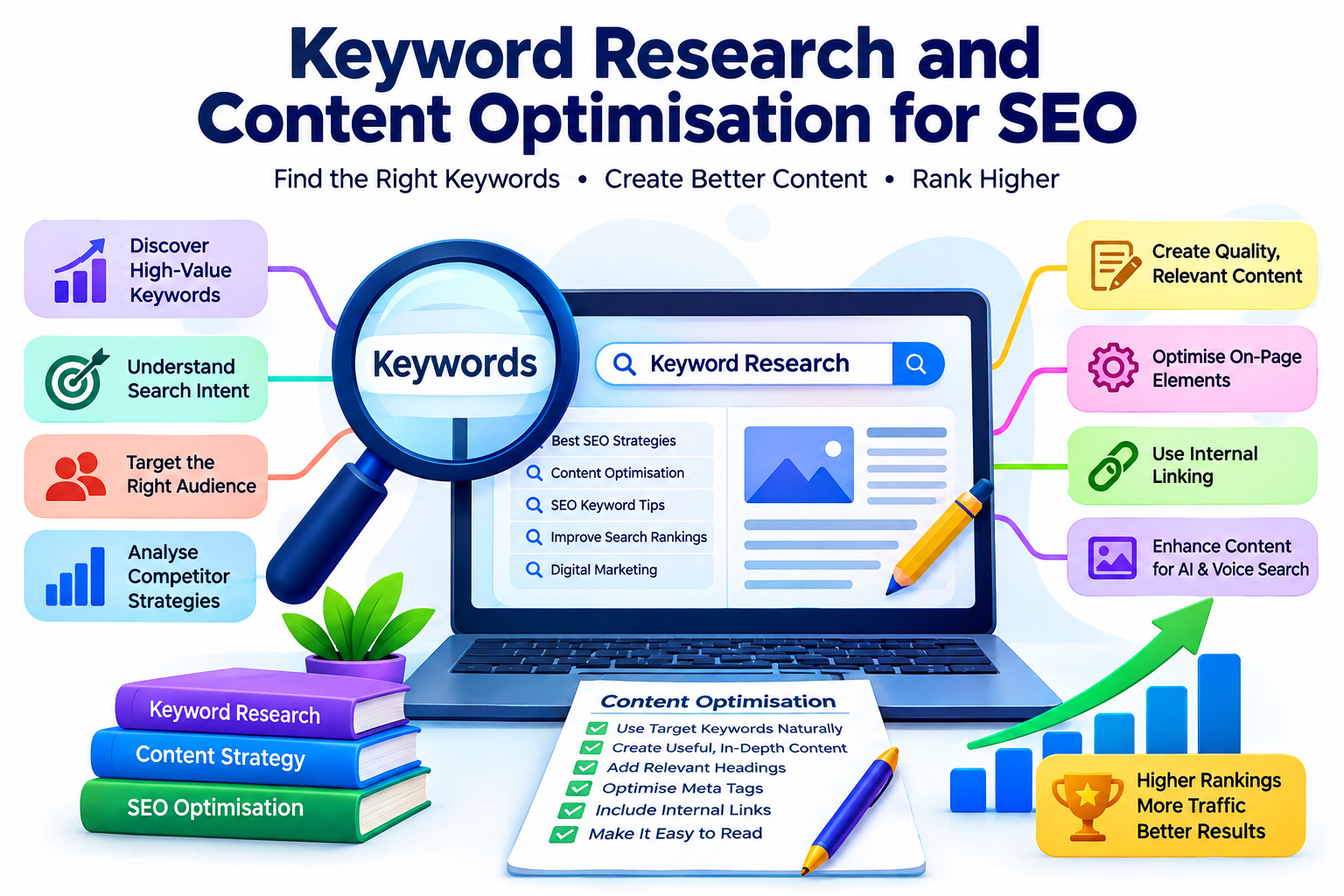
You can publish useful content consistently and still struggle to attract organic traffic if you target the wrong keywords. Effective SEO starts with understanding what your audience searches for, why they search for it, and what type of content can best answer their needs.
Keyword research helps you discover the language your potential customers use when looking for information, products, or services. Content optimisation then turns those insights into useful, search-friendly pages that satisfy users and search engines.
When you combine keyword research with helpful content, strong topical relevance, clear structure, and local search signals, you create a stronger foundation for long-term visibility. You also make your content easier for traditional search engines, AI-powered search platforms, and answer engines to understand.
Keyword research is the process of identifying and evaluating search terms that your target audience uses online. These terms can range from broad phrases such as “SEO services” to highly specific searches such as “local SEO services for small businesses.”
Your goal should not be to collect as many keywords as possible. Instead, you should identify terms that align with your audience, business objectives, and content purpose.
Start by considering:
You can then group related keywords according to topic and search intent.
Search intent describes the reason behind a search. Understanding it helps you create content that matches what users actually want.
Four common types of search intent include:
Informational intent: The user wants to learn something, such as “how does keyword research work?”
Navigational intent: The user wants to find a specific website, brand, or page.
Commercial investigation: The user is comparing solutions before making a decision, such as “best SEO packages for small businesses.”
Transactional intent: The user is ready to take action, such as purchasing a service or requesting a consultation.
Before writing a page, examine the likely intent behind your primary keyword. If people are looking for a guide, a sales-heavy landing page may not satisfy them. If users are ready to hire a provider, a general educational article may not provide enough information.
Matching intent improves relevance and can contribute to stronger engagement.
Avoid creating separate pages for every minor keyword variation. Search engines increasingly understand relationships between words, concepts, entities, and topics.
Instead, build topic clusters.
For example, a main topic such as SEO services could include supporting subjects such as:
This approach allows you to create comprehensive coverage around a subject while giving search engines clearer contextual signals.
Your primary keyword should establish the central topic, while related terms naturally expand the depth of the page.
High search volume can look attractive, but it does not automatically mean a keyword is valuable.
A keyword with 10,000 monthly searches may generate little business value if the search intent does not match your services. A highly relevant keyword with lower search volume may attract fewer visitors but produce more qualified leads.
Evaluate keywords using factors such as:
You should also consider long-tail keywords. These longer and more specific phrases often reveal clearer intent and can help you reach users who are further along in the buying journey.
Once you select your keywords, incorporate them naturally into your content. Avoid forcing the same phrase repeatedly into every paragraph.
Your primary keyword can appear in strategic areas such as:
Use related terminology throughout the article to demonstrate topical depth.
For example, an article about keyword research could naturally discuss search intent, long-tail keywords, keyword difficulty, content gaps, semantic relevance, SERPs, topic clusters, and conversion-focused queries.
The objective is not keyword density. The objective is clarity, usefulness, and topical completeness.
AEO, or Answer Engine Optimisation, makes direct answers especially important.
Structure your content so users can quickly find the information they need. Use clear headings, concise explanations, lists, definitions, and question-based sections.
Instead of writing a vague introduction, answer the central question early.
For example:
What is keyword research?
Keyword research identifies the search terms your audience uses and helps you select relevant topics and phrases for your SEO content strategy.
You can then expand on the answer with examples, practical steps, and supporting information.
This structure helps readers scan your content while making important information easier for search systems and AI-powered answer engines to interpret.
Search behaviour continues to evolve beyond traditional blue-link results. AI-powered search experiences can interpret questions, combine information, and provide conversational answers.
To make your content easier for these systems to understand, focus on:
Avoid writing exclusively for algorithms. Write for people first, then make the information easy for machines to interpret.
Your content should demonstrate expertise and provide genuine value rather than simply repeating keywords.
Experience, Expertise, Authoritativeness, and Trustworthiness are important principles for creating credible content.
You can strengthen these signals by demonstrating practical knowledge, explaining processes accurately, using reliable information, and making your business identity clear.
Where appropriate, include author information, credentials, case studies, examples, original observations, customer-focused explanations, and transparent business details.
Do not make unsupported claims simply to sound authoritative. Clear, accurate, useful information is more valuable than exaggerated marketing language.
If you serve a specific city, region, or service area, incorporate local relevance into your keyword and content strategy.
For example, instead of targeting only “SEO services,” you may target searches such as “SEO services in Delhi” or “local SEO agency in Delhi,” when those phrases accurately represent your business and audience.
Create genuinely useful location-specific content rather than replacing a city name throughout an otherwise identical page.
Your local SEO strategy can include:
GEO, or Generative Engine Optimisation, can also benefit from strong entity information and clear geographic context. Make it easy for search systems to understand who you serve, what you offer, and where you operate.
Keyword research should not stop when you publish an article.
Review existing pages to identify missing questions, outdated information, weak sections, and topics competitors cover more effectively.
You can perform a content gap review by comparing your page with relevant search results and asking:
Update content when there is a genuine reason to improve it. Do not change text simply to insert more keywords.
Internal linking helps users discover related information and helps search engines understand the relationship between pages.
Use descriptive anchor text that tells readers what they will find after clicking. For example, if you want to introduce a service page, an anchor such as Pro SEO Packages is more informative than generic text such as “click here.”
You can explore Pro SEO Packages when discussing how professional SEO solutions can support a broader keyword and content strategy.
Connect related blog posts, service pages, guides, and resource pages where the connection is genuinely useful. Avoid adding internal links simply to increase the number of links on a page.
SEO content should be measured against meaningful outcomes.
Monitor metrics such as:
Use tools such as Google Search Console and analytics platforms to identify which pages are gaining visibility and which need improvement.
If a page receives impressions but few clicks, review its title and search-result presentation. If it attracts visitors but generates no conversions, examine its intent alignment, calls to action, page experience, and content relevance.
SEO works best as an ongoing process rather than a one-time publishing exercise.
Several mistakes can weaken your results.
Targeting only high-volume keywords: High volume does not guarantee relevance or conversions.
Ignoring search intent: A page can rank for a phrase and still fail to satisfy the user.
Keyword stuffing: Repetitive keyword usage can make content unnatural and difficult to read.
Creating thin pages: Pages with little useful information provide limited value.
Ignoring long-tail searches: Specific queries can reveal highly qualified users.
Neglecting local intent: Businesses serving specific locations should consider geographic search behaviour.
Forgetting existing content: Updating and improving strong pages can be more effective than continuously creating new ones.
You can simplify your process by following a repeatable workflow:
This process helps you avoid random keyword targeting and creates a more consistent SEO strategy.
Keyword research and content optimisation work together. Research tells you what your audience is searching for, while optimisation helps you deliver information that meets those needs.
When you combine search intent, topic coverage, natural keyword usage, internal linking, E-E-A-T principles, AEO-friendly answers, AI search considerations, and local relevance, your content becomes more useful to both people and modern search systems.
Focus on solving problems rather than chasing rankings alone. When your content genuinely answers questions, demonstrates expertise, and provides a clear next step, you create stronger opportunities for sustainable organic visibility and conversions.
Keyword research helps you understand what your audience searches for. It allows you to select relevant topics, match search intent, prioritise valuable opportunities, and create content that addresses genuine user needs.
Focus on one primary topic and naturally cover closely related terms. Avoid assigning dozens of unrelated keywords to one page. Your content should be comprehensive enough to address the subject without becoming repetitive or forced.
Search intent is the reason behind a user’s search. It generally falls into informational, navigational, commercial, or transactional categories. Understanding intent helps you create content that matches what searchers actually want.
Keyword research identifies location-specific searches and customer needs. You can use these insights to create relevant local pages, optimise business information, answer local questions, and improve visibility for geographically focused searches.
Yes. Updating content can improve accuracy, relevance, completeness, and user experience. Review pages periodically for outdated information, missing topics, weak internal links, changing search intent, and opportunities to provide better answers.
If you need help developing a stronger keyword, content, and search optimisation strategy, take the next step with a professional SEO solution. You can also use Contact Us as a descriptive internal anchor for your enquiry page