

How Pro SEO Packages Improve Search Visibility
Sep 1, 2026
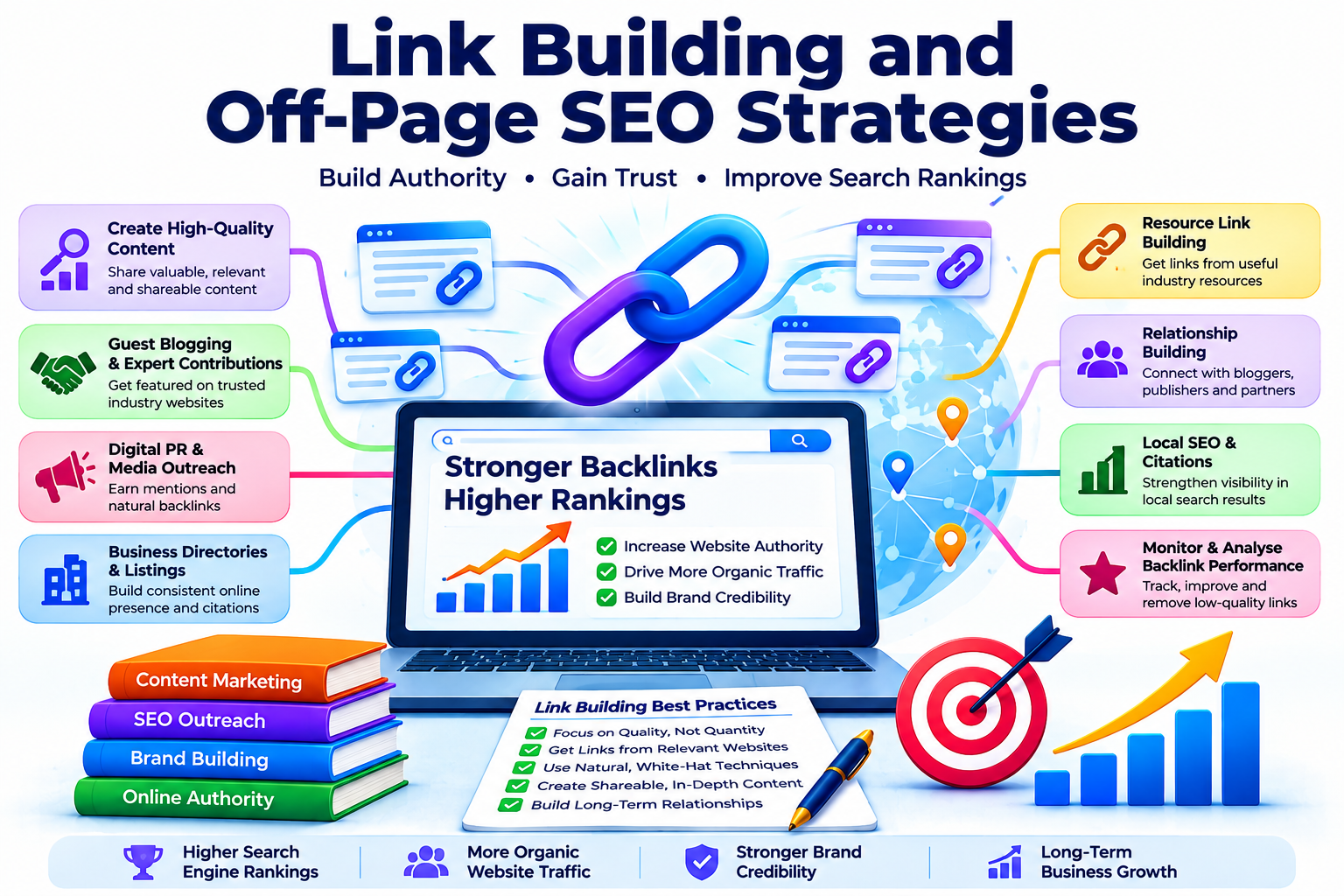
Link building and off-page SEO can strengthen your website’s authority, improve its online reputation, and help you compete for valuable search positions. While on-page SEO focuses on what happens directly on your website, off-page SEO builds trust through external signals such as backlinks, brand mentions, citations, reviews, and digital relationships.
You can think of off-page SEO as your website’s reputation beyond its own pages. When relevant and trustworthy websites reference your content, search engines gain additional context about your expertise and credibility. However, successful link building is not about collecting as many links as possible. It is about earning the right links from relevant, authoritative sources.
This guide explains practical link-building and off-page SEO strategies you can use to create a stronger, more sustainable search presence.
Link building is the process of earning hyperlinks from other websites to your own. A backlink can direct visitors to your website while also providing search engines with a signal about your content.
For example, if an established industry publication references your detailed guide and links to it as a useful resource, that link can contribute to your website’s authority.
However, not every backlink has the same value. A relevant link from a respected website can be considerably more useful than numerous links from unrelated, low-quality domains.
Your goal should be to build a backlink profile based on:
Quality should always come before quantity.
Your website can have technically sound pages and valuable content, yet still struggle to compete if it lacks external authority.
Off-page SEO helps you establish credibility beyond your website. Strong external signals can support several important goals, including:
You should also remember that SEO results rarely come from a single tactic. Your content, technical foundation, internal linking, user experience, local presence, and off-page signals should work together.
The most sustainable link-building strategy begins with content that people genuinely want to reference.
Instead of creating content simply to target keywords, develop resources that solve specific problems or provide information that is difficult to find elsewhere.
You can create:
Before publishing, ask yourself whether another website owner would have a genuine reason to cite your resource. If the answer is no, improve the content before beginning outreach.
Relevance is one of the most important considerations when evaluating backlink opportunities.
A website covering topics related to your industry is generally a more natural linking environment than an unrelated website. For example, a technology company should prioritize relevant technology publications, business resources, software directories, and industry websites rather than unrelated sites that offer links to every possible niche.
You should evaluate potential websites based on:
Do not judge a website solely by a third-party authority score. Use several quality indicators before deciding whether an opportunity is worthwhile.
Guest posting can support both link building and brand exposure when you approach it properly.
Instead of submitting generic articles to websites that publish anything, identify publications with an audience that matches your target customers. Study their existing content, understand their editorial requirements, and pitch a genuinely useful topic.
Your contribution should provide value even if the backlink did not exist.
Keep your author or contextual links natural. Avoid stuffing exact-match keywords into every link, as unnatural anchor patterns can make your backlink profile look manipulative.
Effective link building is often relationship building.
You can connect with editors, bloggers, journalists, publishers, industry experts, and complementary businesses. Share useful resources without immediately asking for a backlink.
For example, if you publish original research, you can introduce it to relevant writers who regularly cover your subject. If the research is valuable to their audience, they may reference it naturally.
Personalize your outreach by mentioning the recipient’s content and explaining exactly why your resource could help their readers.
Short, relevant, personalized outreach generally works better than mass-produced messages.
Your brand may already be mentioned online without receiving a backlink.
Search for references to your company, products, services, executives, or original research. When you find a relevant unlinked mention, contact the website owner and politely ask whether they would consider linking the mention to an appropriate page.
This strategy can be efficient because the website has already demonstrated interest in your brand.
You can also monitor:
Only request links where they genuinely improve the reader’s experience.
If you operate a local business, combine traditional link building with local SEO.
Look for legitimate opportunities through local organizations, business associations, chambers of commerce, community publications, event websites, local news outlets, and relevant regional directories.
You can also participate in community events, sponsorships, workshops, and industry activities that generate authentic local visibility.
Local relevance matters because search engines need to understand where your business operates and which communities it serves.
Keep your business information consistent across important platforms, particularly your business name, address, phone number, website, and service details.
Digital PR can generate high-quality backlinks while increasing brand awareness.
You can create newsworthy campaigns around:
Journalists and publishers need credible sources and useful information. If you provide original data or expert insights that support a story, your website may earn editorial coverage.
The strongest digital PR campaigns focus on news value rather than simply requesting backlinks.
Resource pages can provide useful link-building opportunities when your content genuinely fits the page.
You can also identify broken external links on relevant websites. If you have a current resource that replaces the missing information, you can contact the website owner and suggest your page as an alternative.
The important point is relevance. Do not recommend your content merely because a broken link exists. Your replacement should actually solve the same problem for the website’s audience.
Not every backlink is beneficial.
Avoid strategies based on manipulating rankings, including excessive link exchanges, automated link creation, irrelevant directory submissions, private networks designed solely for ranking manipulation, and large-scale paid links intended to pass ranking value.
You should also be cautious about services promising hundreds or thousands of backlinks within a few days.
A healthy backlink profile develops naturally over time. A smaller number of relevant, trustworthy links can be more valuable than a large collection of questionable links.
A backlink cannot compensate for poor website quality.
When someone clicks your link, they should land on a page that answers their question quickly and clearly. Make sure your destination pages have:
You can also explore Pro SEO Packages if you need a structured approach to improving your website’s broader search performance.
Anchor text is the clickable wording used in a hyperlink.
You should avoid using the same keyword-rich anchor text repeatedly across your backlink profile. Instead, maintain a natural mixture of branded, descriptive, topical, and URL-based anchors.
For example, links may naturally use phrases such as:
The anchor should accurately describe the destination and make sense within the surrounding sentence.
Link building should not end after you acquire a backlink.
Regularly review your referring domains and identify changes in your backlink profile. Look for new links, lost links, unusual patterns, irrelevant domains, and opportunities for additional outreach.
You can track metrics such as:
Avoid judging success by backlink numbers alone. The real objective is to improve visibility, credibility, qualified traffic, and business results.
A practical strategy starts with research.
First, analyze your existing backlink profile and identify gaps. Next, study competitors to understand which relevant websites are already linking to similar businesses. Then create content that can compete for those opportunities.
After publishing, develop a targeted outreach process. Track the websites you contact, the resources you promote, responses, acquired links, and future relationship opportunities.
You should review your strategy regularly rather than relying on one campaign. Search behavior changes, competitors publish new resources, and valuable linking opportunities appear over time.
For professional guidance, you can also Contact Us to discuss your SEO requirements and determine which off-page strategies fit your website and business goals.
Modern search visibility extends beyond traditional blue links. Search engines and AI-powered systems increasingly rely on trustworthy, well-structured information to understand entities, topics, businesses, and sources.
That means your off-page strategy should support broader visibility across search experiences.
Build authoritative content, earn credible mentions, maintain consistent business information, and develop relationships with reputable sources. These activities can strengthen the signals surrounding your brand and make your organization easier to understand across search and AI-driven discovery environments.
For local businesses, include location-specific expertise and maintain accurate business information across relevant platforms. For broader businesses, focus on topical authority, expert contributions, original research, and industry recognition.
Successful link building is not a numbers game. Your priority should be earning relevant, credible, editorially appropriate links that support your users and reinforce your expertise.
Create valuable content, build genuine relationships, personalize outreach, strengthen local visibility, monitor your backlink profile, and avoid manipulative shortcuts. When these activities work alongside strong technical and on-page SEO, you can build a more resilient search strategy.
Most importantly, focus on earning recognition rather than simply collecting links. The best off-page SEO strategy makes your website worth referencing, your brand worth mentioning, and your content worth sharing.
Link building helps you earn references from other websites. Relevant, trustworthy backlinks can support your website’s authority, referral traffic, brand visibility, and overall SEO performance when they are earned naturally and point to useful content.
There is no ideal backlink number. You should focus on earning relevant, high-quality links instead of chasing a specific quantity. A smaller number of authoritative links can provide more value than hundreds of irrelevant or low-quality backlinks.
No. Backlinks vary in quality and relevance. Links from trustworthy, relevant websites can be valuable, while manipulative, irrelevant, or low-quality links may provide little benefit and can create unnecessary SEO risks.
Guest posting can help when you contribute genuinely useful content to reputable, relevant websites. The primary focus should be audience value, expertise, and brand exposure rather than publishing low-quality articles solely to obtain backlinks.
Link-building results vary by website, competition, content quality, industry, and the authority of acquired links. You should treat link building as a long-term strategy and evaluate progress through rankings, organic traffic, referral visits, visibility, and conversions.