

How Pro SEO Packages Improve Search Visibility
Sep 1, 2026
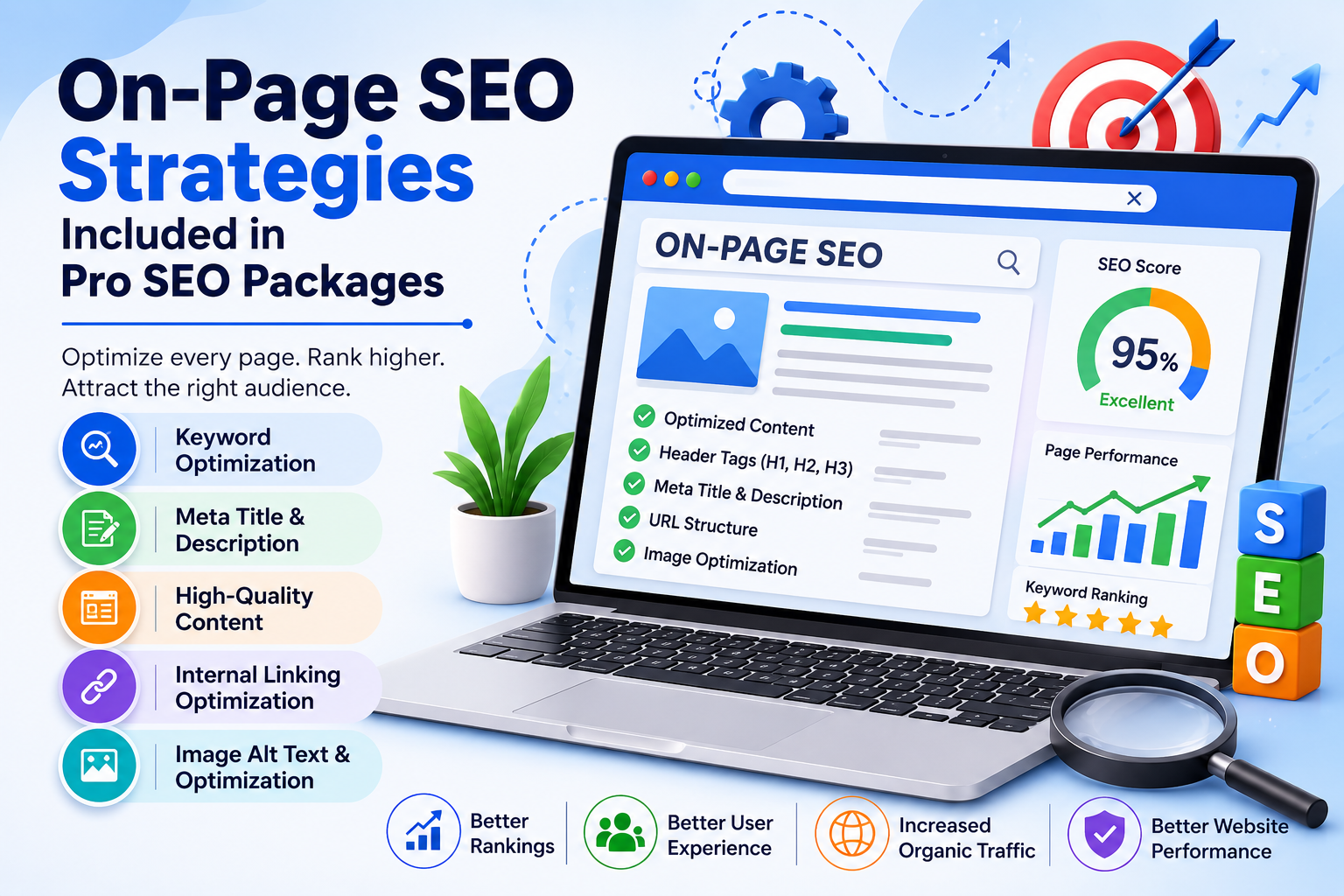
On-page SEO is the foundation of a website that performs well in search results. Even if you have excellent products, services, or expertise, your pages need to be structured and optimized so search engines and users can understand their value. A well-planned on-page SEO strategy improves relevance, usability, visibility, and the chances of appearing for valuable search queries.
When you choose Pro SEO Packages, you can use a structured approach to optimize the elements that influence how your pages are understood and experienced. From keyword placement and headings to content quality, internal linking, metadata, and search intent, each element contributes to a stronger organic search presence.
This guide explains the key on-page SEO strategies you should expect from a comprehensive SEO package and how you can use them to improve your website.
On-page SEO involves optimizing the elements within your website to help search engines understand your content and users find useful information quickly. Unlike off-page SEO, which focuses on external signals such as backlinks, on-page optimization gives you direct control over your website.
You can optimize page content, titles, headings, URLs, images, internal links, structured data, and other elements to make each page more relevant and accessible.
A strong on-page strategy should accomplish three things:
Effective on-page SEO starts with understanding what your audience searches for. Your SEO strategy should identify relevant primary, secondary, long-tail, and question-based keywords.
Instead of repeatedly inserting one keyword into a page, you should use keywords naturally throughout the content. Strategic placement can include the page title, introduction, headings, body copy, URL, image alt text, and metadata where appropriate.
You should also consider search intent. Someone searching for “technical SEO services” may be looking for a service provider, while someone searching for “what is technical SEO” is probably looking for educational information.
Matching your content to intent helps you attract visitors who are more likely to engage with your website.
Your SEO title provides search engines and users with an immediate understanding of your page. A strong title should clearly communicate the topic while naturally incorporating the primary keyword.
Your meta description should provide a concise summary of the page and encourage qualified users to click. Although it is not simply a ranking-factor exercise, an accurate and compelling description can improve the attractiveness of your search listing.
For better results, avoid:
Each important page should have unique metadata aligned with its actual content.
Headings help you organize information into logical sections. They also make long pages easier to scan.
Your primary heading should clearly identify the page topic. Supporting H2 and H3 headings should then divide the content into meaningful sections.
For example, a page about on-page SEO could use sections such as:
A logical heading structure improves readability and gives search engines additional context about the relationships between topics.
Modern SEO is not simply about placing keywords on a page. You need to answer the questions and concerns behind those searches.
When optimizing content, consider:
Your content should provide direct answers before expanding into supporting details. This approach is particularly useful for AEO because answer engines can identify concise, well-structured information more easily.
High-quality content should demonstrate knowledge, usefulness, relevance, and credibility. Instead of creating pages solely to target keywords, you should build content around topics your audience genuinely needs.
A strong page can cover the primary subject while addressing related questions, examples, definitions, benefits, limitations, and practical recommendations.
You should also keep content updated when information changes. Removing outdated information and improving weak sections can help maintain the usefulness of important pages.
For businesses using Pro SEO Packages, comprehensive content optimization can become part of a broader strategy that connects individual pages to larger topic clusters.
Internal links connect related pages on your website. They help visitors discover additional information while giving search engines signals about your website structure.
You should create links using descriptive anchor text rather than generic phrases such as “click here.”
For example, instead of writing “Click here to learn more,” use descriptive anchor text such as technical SEO services, local SEO strategies, or SEO content optimization when those phrases accurately describe the destination page.
A strong internal linking strategy can:
Avoid adding links simply for the sake of increasing the number of internal links. Every link should provide genuine value.
Your URLs should be simple, descriptive, and easy to understand. A clean URL gives both users and search engines useful context about the page.
For example, a URL such as:
example.com/on-page-seo
is easier to understand than:
example.com/page?id=8274
Where possible, keep URLs concise and use meaningful words related to the page topic. Avoid unnecessary parameters, excessive folders, and keyword repetition.
You should also maintain URL consistency when restructuring your website. If a URL must change, use appropriate redirects to reduce disruption.
Images can improve engagement and make complex information easier to understand, but they should also be optimized.
You should compress large image files, use suitable formats, and avoid uploading unnecessarily oversized images. Descriptive file names can also provide additional context.
Alt text should describe the image accurately when the image conveys meaningful information. Do not use alt text as an opportunity to stuff keywords.
For example, an image showing a website SEO audit could use descriptive alt text such as “SEO audit report showing website optimization issues.”
Good image optimization can support accessibility, page performance, and image search visibility.
If you want your content to perform in AI-powered and answer-focused search experiences, structure information so important answers are easy to identify.
Use concise definitions, direct answers, question-based headings, bullet points, numbered steps, and informative FAQs where appropriate.
For example, if a page targets the question “What is on-page SEO?”, provide a direct definition immediately below the heading before discussing the topic in greater depth.
This structure can make content easier for users to scan while also supporting AEO and GEO-focused optimization.
Your website should communicate why visitors should trust your information, products, or services. Demonstrating experience, expertise, authoritativeness, and trustworthiness can strengthen the overall quality of your website.
You can support these signals by providing:
Trust should be reflected throughout your website rather than added to one page as an afterthought.
If you serve a specific city, region, or service area, on-page SEO should reflect your local audience.
Create genuinely useful location-specific content rather than producing multiple pages with nearly identical text and different city names.
Your local pages can include relevant services, areas served, customer needs, local references, business information, and location-specific FAQs.
Consistent business information and appropriate local structured data can further support local search visibility.
Your pages need to work effectively on smartphones and tablets. Mobile users should be able to read your content, navigate menus, interact with buttons, and complete forms without unnecessary difficulty.
Keep paragraphs manageable, use descriptive headings, maintain adequate spacing, and avoid intrusive elements that interfere with the main content.
You should also monitor page speed and Core Web Vitals because performance affects the overall user experience.
Structured data helps you communicate specific information about your pages to search engines in a standardized format.
Depending on your website, relevant structured data may describe organizations, products, services, articles, breadcrumbs, events, or other supported entities.
You should implement structured data accurately and ensure that the information in the markup matches visible page content. Incorrect or misleading structured data can create problems rather than benefits.
SEO is not a one-time task. Search trends, competitors, user expectations, and your own business information can change.
Regular on-page audits help you identify:
You can then prioritize improvements according to traffic potential, business value, search visibility, and the level of effort required.
Effective on-page SEO works best when individual optimizations support one another. Keyword research informs content planning. Content structure supports search intent. Internal linking connects related topics. Metadata improves search-result presentation, while technical improvements support accessibility and usability.
Instead of treating every optimization separately, you should develop a consistent system for improving your website.
A professional SEO package can help you identify priorities, implement changes, monitor performance, and continually refine your strategy based on measurable results.
Your website should do more than contain keywords. It should answer real questions, demonstrate expertise, provide a smooth experience, and make important information easy to discover.
Start by reviewing your most important pages. Check whether each page targets a clear search intent, uses descriptive headings, has unique metadata, provides useful information, connects to relevant internal pages, and works well on mobile devices.
If you need help developing a structured optimization strategy, use Contact Us to discuss your SEO requirements and identify opportunities for improving your website’s organic search performance.
On-page SEO can include keyword optimization, titles, meta descriptions, headings, content improvements, internal linking, URLs, image optimization, structured data, user experience improvements, and content updates.
Strategic keyword placement helps search engines understand the subject of your page. However, keywords should appear naturally and support user intent rather than being repeated excessively.
Internal links help users discover related information and help search engines understand your website structure. Descriptive anchor text can also provide context about the linked page.
Yes. Location-focused content, relevant local information, consistent business details, structured data, and service-area pages can support local search visibility when implemented naturally.
You should review important pages regularly and update them when information, search intent, business offerings, or search performance changes. High-value pages may require more frequent monitoring than low-priority pages.
On-page SEO gives you direct control over many factors that influence how your website is understood by search engines and experienced by visitors. By combining strategic keywords, useful content, clear structure, internal linking, optimized metadata, strong trust signals, mobile usability, and local relevance, you can build pages that are more useful and search-friendly.